Dear designer,
Here's what a design job can cost you without anyone noticing.
The client asks for a few free ideas, and a cheaper crew builds them. Round four of revisions turns an $87 hour into a $67 hour. A patio tilts toward the back door, and you get the call after the first storm.
None of that shows up on the invoice. All of it comes out of your pay and your name.
Every one of those is a decision you've made before: what to charge, how many rounds, how much fall, where the screen goes. The Landscape Black Book writes each one down once, with the numbers and a named source, so you can open it on site, show it to a client and use it on every job.
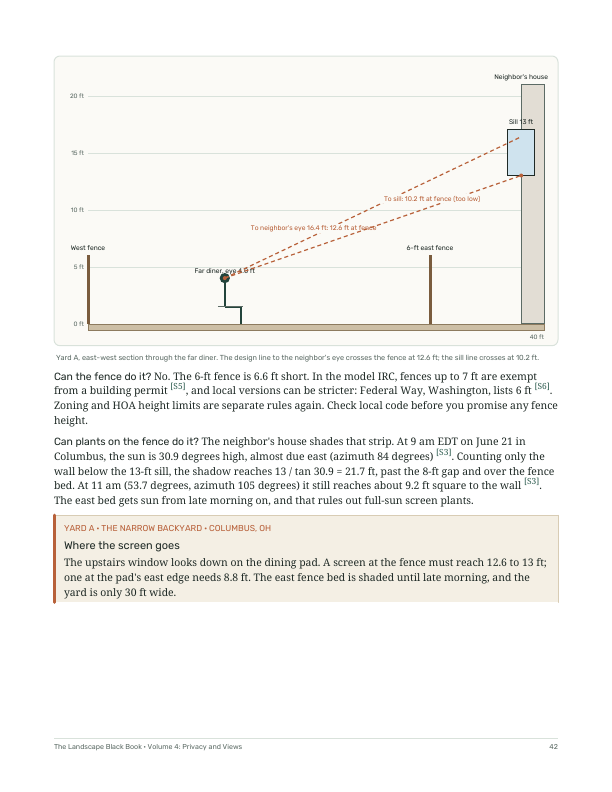
Take the upstairs window. The client sits on the new patio and points up. A screen on the fence would have to stand almost 13 ft tall to block that window from the chair. Move it to the edge of the patio and about 9 ft does the job. One section drawing proves it before anyone asks for a taller fence.
Why another course won't fix it
You know how to design. A course teaches what you already know, and a Pinterest board shows the finished garden, never the decision behind it.
What eats your week is the work around the drawing: reading the site, pinning down the brief, sizing the patio for a real dinner, placing the screen, choosing plants that still fit in year five, keeping water off the house, lighting the yard for the hours they use it, holding the line on revisions, and charging enough for all of it.
Each of those is a decision you've made before. You just don't have it written down in a way you can open on site, show a client, and reuse.
The Landscape Black Book: every decision, worked out once
Twelve volumes. Each one takes one part of a residential job, gives you the checks and the numbers, and works the real decisions on three case yards: a narrow backyard in Ohio, a sloped front yard in North Carolina and a bare new-build lot in Texas.
- Volume 1, The Site Walk. One walk order that catches sun, water, soil, slope, wind, utilities, trees and views on the first visit.
- Volume 2, The Client Brief. Ask the budget before you draw, map how they'll use the yard by the hour, and turn "it feels empty" into a fix.
- Volume 3, Layout, Paths and Room Sizes. Real sizes for a table for six, path widths, step proportions and the busy-Saturday test.
- Volume 4, Privacy and Views. Block the view from the seat, not the property line, with the math to place and size the screen.
- Volume 5, Planting by Job. Pick plants for the job first (screen, structure, filler, ground cover), then space them from mature width.
- Volume 6, Plants That Last. Zones, sun, soil and year-five size, plus what a substitute must match when the nursery is out.
- Volume 7, Hard Surfaces. Start from what the surface has to do: wet grip, heat on bare feet, freeze-thaw, base depth and tree roots.
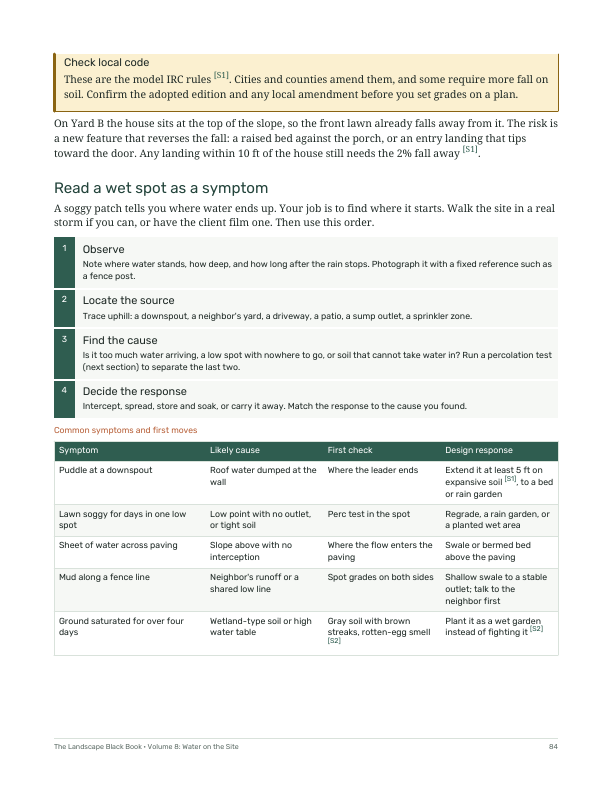
- Volume 8, Water on the Site. Read the wet corner as a symptom, grade away from the house, size a rain garden, and know when to call an engineer.
- Volume 9, Light and Evening Use. Light the yard for the hours they use it, in layers, without glare for the neighbors.
- Volume 10, Maintenance Plans. Estimate the hours a design will take to keep up, and hand over a plan for years 1, 3 and 5.
- Volume 11, Present, Revise, Hand Off. Present a decision, hold two revision rounds, and lock what the crew may change.
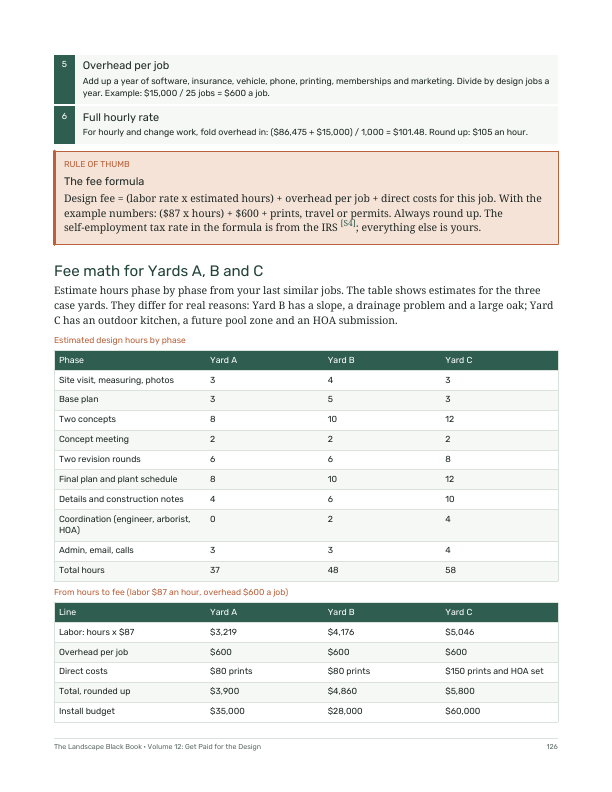
- Volume 12, Get Paid for the Design. Hourly, flat or percent of install, the fee math worked for all three yards, paid site visits and deposits.
Every number has a source, listed at the end of its volume: extension services, USDA, the ADA, the IRC, manufacturer specs. Where a job needs an engineer, an arborist or an electrician, the volume says when.
$27 once · Instant download · Use it on your next site visit
Who it's for
- Garden and landscape designers who draw residential plans and want each job to start from page one, not a blank sheet.
- Design-build owners who draw plans to sell installs and want the plan to hold up on install day.
- Newer designers with their first paying clients, who want the checks and the fee math a few years of jobs would teach them.
It doesn't teach design from the start, and it doesn't replace local codes, engineering, an arborist or a lawyer. It covers the decision work around your design, done once and written down.
Here’s everything you get
The volumes cover the design. The five bonuses are the tools you hand to the job and to the client.
The core
The 12 volumes
Every decision from the site walk to the fee, worked on three real yards, with a one-page check at the end of each volume. Print and phone editions.
Value $27
Bonus 1 · for “I always forget something on site”
The Site Walk Card
The whole walk on one card, in walk order, on your phone or a clipboard.
Value $9
Bonus 2 · for “which plant does this job here?”
Plant Job Cards
One card per planting job, with the spacing rule and sourced example plants for zones 6b, 8a and 9a.
Value $13
Bonus 3 · for “they never told me the budget”
Client Intake Questionnaire
A fillable form the client completes before you visit, budget question included.
Value $9
Bonus 4 · for “just one more change”
Revision and Change Form
Two-round scope wording and a fillable change form with fee and sign-off.
Value $9
Bonus 5 · for “the plants died, whose fault?”
Client Care Guide
A fill-in handout for handover: first-year watering, mulch, pruning and who to call.
Value $9
So what does it cost?
Add up what’s in the kit:
| The 12 volumes | $27 |
|---|---|
| Bonus 1: The Site Walk Card | $9 |
| Bonus 2: Plant Job Cards | $13 |
| Bonus 3: Client Intake Questionnaire | $9 |
| Bonus 4: Revision and Change Form | $9 |
| Bonus 5: Client Care Guide | $9 |
| Total value |
You won’t pay $76. You won’t even pay the $27 the volumes are worth alone, because the bonuses come with them.
Today, the whole kit is $27, one time.
That's less than one billable hour of design time, for a kit you'll open on every job. No subscription, ever.
- 7-day money-back guarantee. Use it on one project. If it didn't save you time on that job, one email gets every cent back.
- Instant PDF download. On your phone in a minute.
- Secure checkout by Stripe.

Now picture your next job
You walk the site once, with the card. The client filled in the budget before you arrived. You show them the section: a 9-ft screen at the patio edge that blocks the window from every chair. They approve it in round one.
The proposal set two revision rounds before you drew a line. The crew knows what they may move and what they may not. And the fee covers the hours, because you did the math first.
Use it on one project. Then decide.
Use the kit on one project. If it didn't save you time on that job, send one email within 7 days and we refund every cent. No forms. No hoops.
So the risk is all ours.